
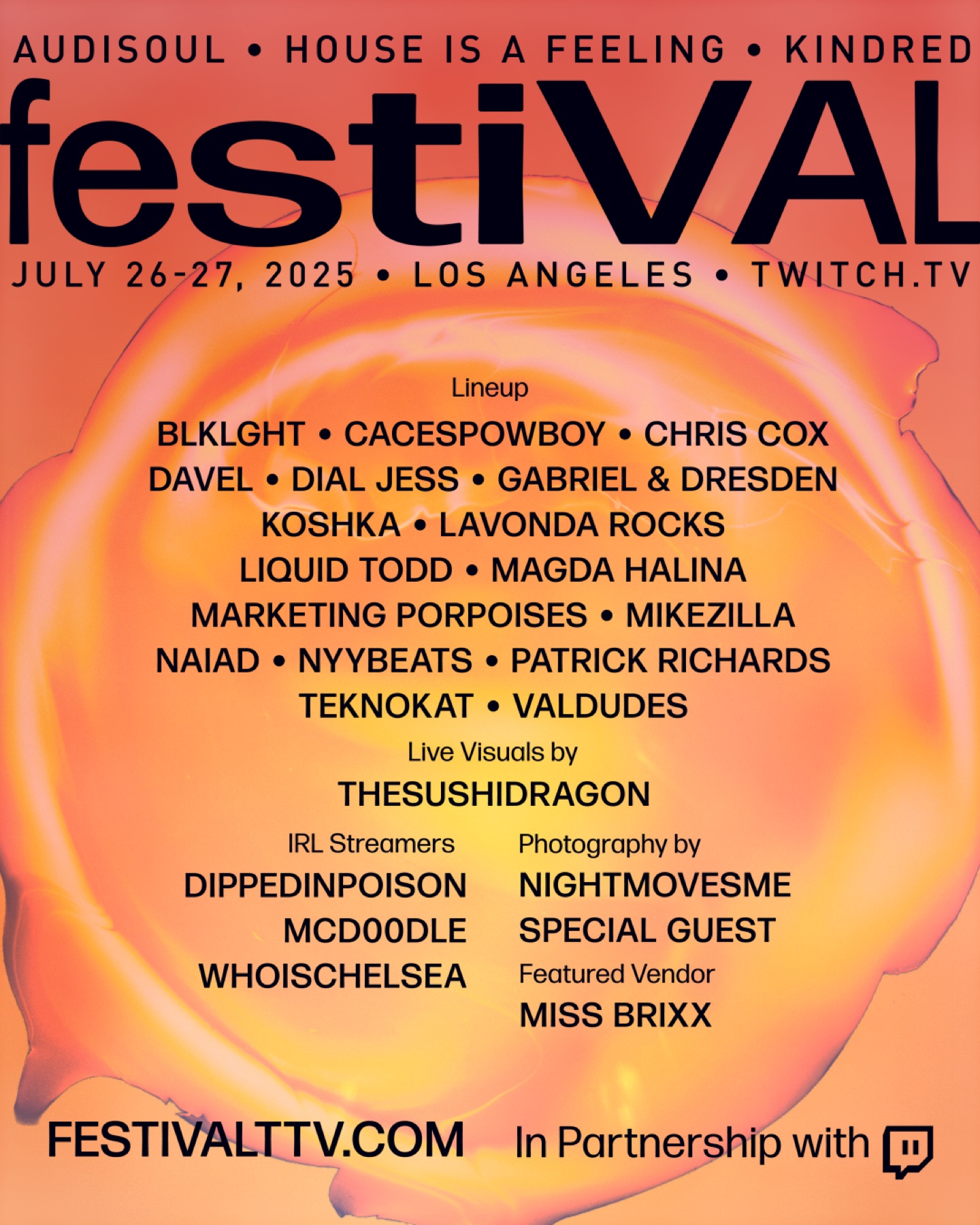
FestiVAL was not a studio stream with a crowd added around it. It was a venue show and a multi-channel online production happening at the same time, with each audience needing a coherent experience.
01 / The format
A 24-hour show needs an operating rhythm
Public coverage described FestiVAL as a 24-hour Los Angeles mini-festival built by Twitch DJ streamers, with multiple channels and camera angles, more than fifteen participating creators and Twitch chat represented inside the venue.
That scale changes the production problem. Artist transitions, crew handoffs, technical checks and audience moments have to repeat without making the show feel repetitive. The plan must survive fatigue as well as equipment failure.
02 / Third Space scope
The venue and broadcast were one system
Third Space handled the complete live production across the physical room and online show: production planning, cameras, switching, broadcast audio, PA, IMAG, lighting, lasers, platform delivery and active monitoring.
The camera plan had to serve both the performance and the audience in the room. Audio choices had to work for the PA and the stream. Lighting and lasers needed to read in person without breaking the picture. Treating those as one system reduced the number of fragile handoffs.
03 / What it shows
Long-form live production is an endurance design problem
A 24-hour broadcast cannot rely on constant improvisation. It needs clear ownership, repeatable transitions, useful monitoring and recovery paths that a changing crew can understand quickly.
FestiVAL shows the kind of hybrid production Third Space is built for: creator-led, technically interconnected and designed for communities in the room and online.
Production scope
- 24-hour livestream
- Multi-camera direction
- Broadcast audio
- PA and IMAG
- Lighting and lasers
- Multi-channel Twitch production